

How to Adopt AI Without Rebuilding Your Business
Your business has changed before, and it has had to keep working through every change. Start there when deciding what to do with AI.
Technology leadership insights on data readiness, AI implementation, and enterprise architecture from Made In Tandem.
Your business has changed before, and it has had to keep working through every change. Start there when deciding what to do with AI.

The machines automated everything in the job description. Four things survived, and they were never in the job description to begin with.
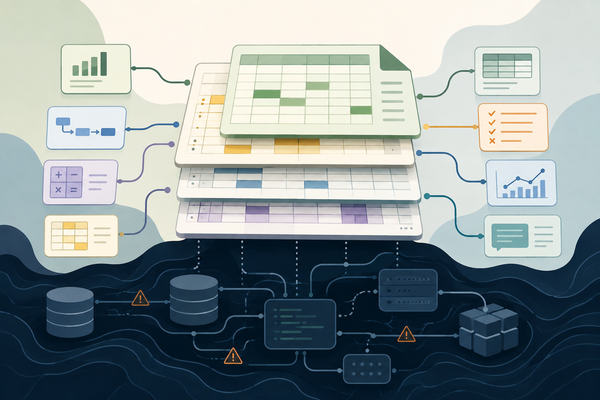
Every shadow spreadsheet marks a spot where the sanctioned systems stopped serving the business. Before you replace them, read them. They're the most accurate requirements documents you own.

You inherited 4 ERPs along with the trucks and the buildings, and the board wants one view of the platform by the first quarterly meeting. Consolidated reporting doesn't require consolidated systems; a shared data layer above them delivers visibility in weeks, not years. Consolidate later, or never.
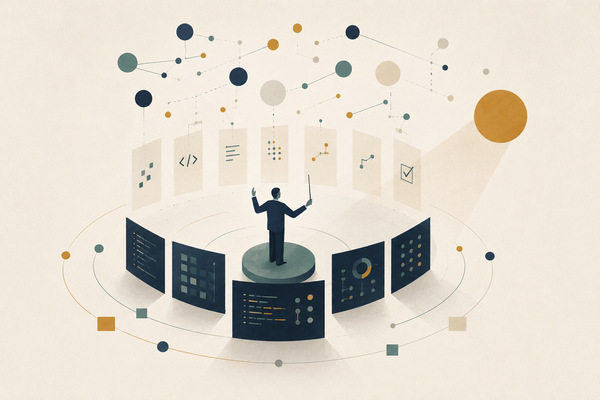
If your teams build software with AI agents, you're already running a production system. The question is: did anyone actually design it?

A test verifies that your code does what the test says. An eval verifies that your system does what the user actually needs.
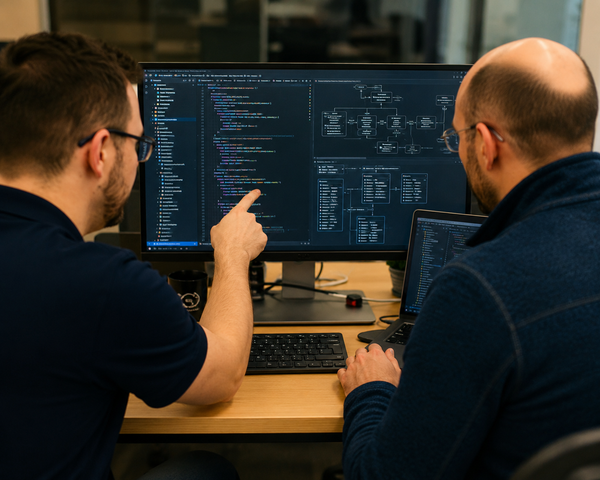
Turning intent into syntax was the expensive part of software, and the entire industry is shaped around that assumption. Agentic AI is collapsing the translation layer, and engineers are migrating up a level, from writing the code to deciding, describing, and judging what it should do.

Integration debt is the cost accumulated between systems when decisions are made without enough information, made rapidly when pacing is more important, or when constraints force your hand. It isn’t in itself a bad thing, but it is limiting. Here's how to measure it and begin paying it down.
We built Made In Tandem around one stubborn idea and held onto it for fifteen years. Then AI showed up, and for a while I was certain it had made that idea worthless. Boy did I have it backwards.
Made in Tandem has earned the Gold Stevie Award in Professional Services at the 2024 American Business Awards. Tandem's work modernizing SDG&E's Emergency Notification System reduced a 37-step process to just ten steps, improving public safety response times.

Future-fit software puts customer needs at the center and enables organizations to adapt quickly as technology and markets evolve. This post explores how embracing modern application development, Agile, and DevOps creates the foundation for resilient, future-ready businesses.

Tandem has been named a winner in the 2023-2024 Cloud Awards for Best Cloud Migration or Systems Integration Solution. The award highlights Tandem's work modernizing MIRS, the military enlistment tracking system, with an AWS GovCloud migration.